Richard Peery and Akio Toyoda: Two Powerful Business Leaders With Very Different Paths to Success

Introduction
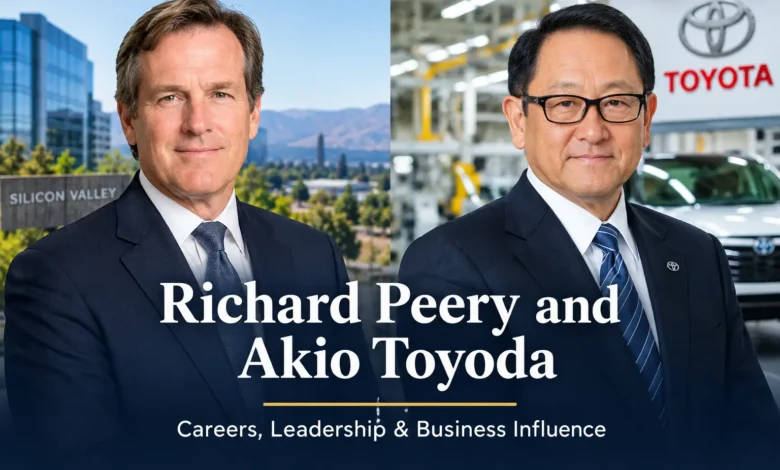
The story of Richard Peery and Akio Toyoda brings together two influential business figures from very different industries. Richard Peery became known for commercial real estate and his role in the development of Silicon Valley, while Akio Toyoda built a long career within Toyota and eventually became chairman of one of the world’s most recognized automobile companies. Their professional backgrounds are different, but both demonstrate the importance of long-term thinking, strategic decisions, and strong leadership.
Richard Peery is an American real-estate entrepreneur associated with the growth of commercial property in Silicon Valley. His partnership with John Arrillaga became particularly significant because the two helped transform farmland into office developments during the region’s technological expansion.
Akio Toyoda, meanwhile, is a member of the Toyota founding family and spent decades working across different parts of the automotive business. He became president of Toyota Motor Corporation in 2009 and later moved into the role of chairman. His career has included manufacturing, international operations, product development, and corporate leadership.
At first glance, there may seem to be little reason to discuss these two people together. One built his reputation through property investment, while the other became a major figure in global automotive manufacturing. However, their stories offer useful lessons about recognizing opportunities and thinking beyond short-term results.
It is also important to clarify that there is no well-established public evidence showing that Richard Peery and Akio Toyoda are relatives or business partners. Their connection in this article is primarily a comparison of two notable careers and leadership journeys.
Who Is Richard Peery?
Richard Peery’s Early Background
Richard Peery is an American businessman and real-estate developer whose career became closely connected with Silicon Valley. He came from a family with a strong background in banking and real estate. His father, H. Taylor Peery, had an influential career in banking and property investment, which gave Richard early exposure to business and financial decision-making.
Peery attended Brigham Young University and later entered Stanford’s MBA program, although he did not complete the degree. Instead, his career moved toward practical business opportunities. This decision reflects an important part of his story: he gained experience through direct involvement in investments and property management rather than following a traditional corporate path.
Even before becoming a major real-estate investor, Peery showed an entrepreneurial mindset. His early activities demonstrated an interest in identifying opportunities and turning relatively simple ideas into businesses. That willingness to experiment later became valuable in commercial real estate.
His career eventually became strongly associated with the development of Silicon Valley. During a period when the region was changing rapidly, Peery and John Arrillaga recognized the potential of commercial property and acquired land that could be developed for businesses.
According to Forbes, Peery and Arrillaga began working together in the 1960s, purchasing farmland and transforming it into office parks. Their work helped establish a substantial commercial property portfolio during Silicon Valley’s growth.
Richard Peery’s Impact on Silicon Valley
Real Estate and Long-Term Investment
Richard Peery’s influence is closely connected to his approach to commercial real estate. Instead of concentrating only on short-term transactions, his career involved acquiring and developing property with a long-term perspective.
The timing was important. Silicon Valley eventually became one of the world’s most important technology centers, creating enormous demand for office and industrial space. Developers who had invested in the area before its transformation were positioned to benefit from that growth.
Peery’s partnership with John Arrillaga became a major part of this story. Their business activities helped create office environments used by companies operating in the technology sector. Fortune has also described their early partnership and its connection to Silicon Valley’s development.
The success of this strategy illustrates why location can be one of the most important factors in real estate. A property that appears ordinary at one point can become extremely valuable when the surrounding economy changes.
Peery’s career therefore provides a useful business lesson: successful investing often requires identifying long-term trends before they become obvious to everyone else.
Who Is Akio Toyoda?
Education and Entry Into Toyota
Akio Toyoda is a Japanese business executive and member of the family associated with Toyota. He was born in 1956 and eventually became one of the most recognizable leaders in the modern automotive industry.
Toyoda studied law at Keio University and later earned an MBA from Babson College in the United States. He joined Toyota in 1984 and gradually gained experience in different parts of the organization.
His career was not limited to executive management. Over the years, he developed experience involving manufacturing, sales, marketing, purchasing, product development, information technology, and international operations.
That broad experience helped prepare him for senior leadership at Toyota. Rather than reaching the top position immediately, he spent decades learning how different parts of the company worked.
Toyoda also gained important international experience through Toyota’s operations in the United States. His career demonstrates how exposure to different markets and business functions can help prepare an executive for complex leadership responsibilities.
Akio Toyoda’s Leadership at Toyota
Becoming Toyota’s President
Akio Toyoda became president of Toyota Motor Corporation in 2009, during a challenging period for the global automotive industry. His leadership years included major economic changes, technological developments, supply-chain challenges, and growing pressure for lower-emission transportation.
As president, Toyoda was responsible for guiding Toyota through an increasingly competitive global market. The company had to respond to changing consumer preferences while maintaining its reputation for manufacturing quality and reliability.
One notable feature of Toyoda’s leadership was his strong personal interest in automobiles. He became closely associated with motorsports and sometimes participated under the name “Morizo.” This helped reinforce his image as an automotive enthusiast rather than simply a corporate executive.
Toyoda also emphasized the importance of making better cars and understanding the emotional side of mobility. His approach connected Toyota’s engineering culture with a broader interest in the experience of driving.
In 2023, Toyoda stepped down as Toyota’s president and became chairman of the board. His transition reflected a change in responsibilities rather than an end to his involvement with the company.
Richard Peery and Akio Toyoda: Different Industries, Similar Lessons
Long-Term Thinking
The careers of Richard Peery and Akio Toyoda are especially interesting because both involve decisions whose results often take years to become visible. Peery’s investments depended on the long-term development of Silicon Valley, while Toyoda’s automotive strategies involved technologies and products that require extensive planning.
Real estate development is rarely successful through quick decisions alone. Land acquisition, construction, leasing, and economic development can take many years. Peery’s career demonstrates the value of patience when an investor believes in the future potential of a location.
The automotive industry has similar characteristics. Developing vehicles, factories, powertrains, and new technologies requires enormous amounts of time and capital. A decision made by an automotive leader today may influence products and operations many years later.
Both careers therefore demonstrate the importance of thinking beyond immediate financial results. Strong leaders often have to make decisions based on where they believe an industry or market is heading.
Their stories also show that successful leadership does not always follow one formula. Peery built his influence through entrepreneurship and investment, while Toyoda developed his through decades of corporate experience.
Their Influence Beyond Business
Education, Philanthropy, and Public Influence
Richard Peery’s influence extends beyond commercial real estate. Education and philanthropy have also been important parts of the broader Peery family legacy.
The H. Taylor Peery Institute of Financial Services at Brigham Young University was supported by a $3 million endowment from Taylor Peery’s children, including Richard Peery and his wife, Mimi. The institute focuses on financial education, research, internships, and connections between students and financial professionals.
This illustrates how business success can be used to support educational opportunities. Investments in education can have effects that continue long after an individual business transaction has ended.
Akio Toyoda’s influence is different because it is closely tied to a global corporation. Toyota operates across numerous markets, making decisions by its leadership relevant to employees, customers, suppliers, and automotive communities around the world.
Toyoda’s public influence has also been strengthened by his interest in motorsports and automotive culture. His enthusiasm for cars has helped give his leadership a personal dimension.
Together, these examples show that business influence can extend beyond a person’s formal job title. It can appear through education, philanthropy, industry development, technology, and public leadership.
What Can We Learn From Their Careers?
Business Lessons From Two Leaders
One of the clearest lessons from Richard Peery and Akio Toyoda is the value of understanding change. Peery operated during the transformation of Silicon Valley, while Toyoda has led within an automotive industry undergoing major technological changes.
Another lesson is the importance of experience. Peery learned about real estate through his family’s background and his own business activities. Toyoda spent decades working in different Toyota operations before becoming the company’s president.
Their careers also demonstrate that successful leaders need to understand their industries deeply. Real estate requires knowledge of locations, financing, development, and demand. Automotive leadership requires knowledge of manufacturing, engineering, customers, technology, and global markets.
Both stories also highlight the importance of adaptability. Markets change, technologies develop, and customer expectations evolve. Leaders who remain open to those changes have a better opportunity to make informed decisions.
Finally, their careers show that a lasting reputation is usually built over many years. Neither story is simply about one successful decision. Their influence developed through decades of work, relationships, investments, and leadership.
Frequently Asked Questions
Who are Richard Peery and Akio Toyoda?
Richard Peery is an American real-estate developer and investor associated with Silicon Valley, while Akio Toyoda is a Japanese business executive and chairman of Toyota Motor Corporation. Their careers developed in different industries.
Are Richard Peery and Akio Toyoda related?
There is no reliable public evidence establishing a family relationship between Richard Peery and Akio Toyoda. They come from different business backgrounds and countries.
What is Richard Peery known for?
Richard Peery is best known for commercial real estate development and investment in Silicon Valley. His long-time partnership with John Arrillaga became particularly important to his business career.
What is Akio Toyoda best known for?
Akio Toyoda is best known for his long career at Toyota, including serving as president from 2009 to 2023 and later becoming chairman. He is also widely recognized for his enthusiasm for automobiles and motorsports.
What industries are associated with Richard Peery and Akio Toyoda?
Richard Peery is primarily associated with real estate, investment, education, and philanthropy. Akio Toyoda is primarily associated with automobiles, manufacturing, mobility, corporate leadership, and motorsports.
Why are Richard Peery and Akio Toyoda compared?
They are interesting to compare because they represent different approaches to long-term business leadership. Peery built wealth through real estate and investment, while Toyoda developed his career within a major global automotive company.
Conclusion
The story of Richard Peery and Akio Toyoda demonstrates that influential business careers can develop in very different ways. Peery became an important figure in Silicon Valley real estate by recognizing the long-term potential of commercial property, while Toyoda built decades of experience within Toyota before taking responsibility for the global automaker.
Their industries may have little in common, but their careers share valuable themes. Both demonstrate patience, experience, strategic thinking, adaptability, and an ability to look beyond immediate results.
Richard Peery’s legacy is connected to Silicon Valley’s physical and economic development, as well as education and philanthropy. Akio Toyoda’s legacy is tied to Toyota’s global automotive presence and its response to a rapidly changing transportation industry.
Ultimately, their stories show that lasting business influence is rarely created overnight. It usually comes from years of learning, making decisions, adapting to change, and recognizing opportunities before they become obvious to everyone else.



One Comment